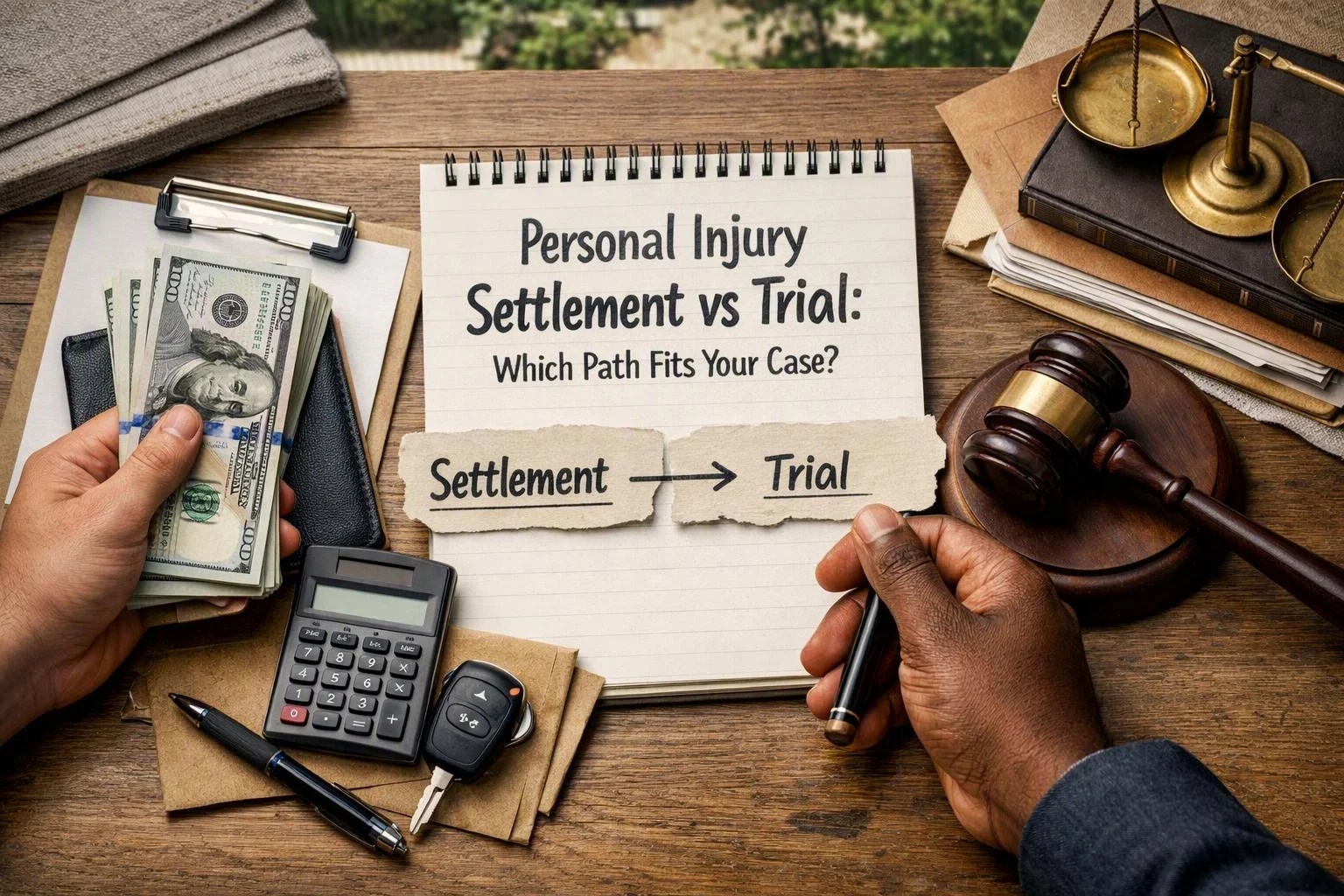
Personal Injury Settlement vs Trial: Which Path Fits Your Case?
A personal injury settlement or personal injury trial depends on liability, comparative fault, damages, evidence, insurance coverage, and your tolerance for risk. Atlanta Auto Law reviews these factors with you, explains the tradeoffs, and recommends the path that best supports your claim and goals.
Written by Ronnie Mabra
Request an EstimateOptions at a Glance
Settlement and trial are two forms of civil dispute resolution for a personal injury claim. The right choice depends on the proof available and the legal risk created by each path.
- Settlement fits people who value control, privacy, and a more predictable case outcome.
- Trial fits claims with strong evidence when negotiations do not produce an acceptable resolution.
Settlement vs Trial: How Do the Paths Compare?
A settlement usually offers more control and predictability, while a trial places the outcome with the court or jury and carries greater uncertainty. Both paths require proof of liability and damages.
| Factor | Personal Injury Settlement | Personal Injury Trial | Decision Focus |
|---|---|---|---|
| Control | The parties agree to the resolution. | The judge or jury decides disputed issues. | How much control you want over the result. |
| Cost | Legal costs may be more predictable. | Additional litigation work can increase case costs. | The work needed to prepare and present the claim. |
| Timeline | The parties control when to resolve the claim. | Court schedules and litigation steps affect timing. | Whether the claim needs a court decision. |
| Risk | The agreed amount resolves the dispute. | The verdict may be higher, lower, or unfavorable. | The strength and limits of the evidence. |
| Best for | Claims with a reasonable negotiated resolution. | Claims requiring a judge or jury to resolve key disputes. | The overall case strategy. |
Neither option guarantees a particular result. We compare the likely benefits and risks before recommending a negotiation strategy or trial strategy.
What Are the Advantages of Settling a Personal Injury Claim?
A personal injury settlement can resolve the claim with more control over the outcome and without leaving the final decision to a jury. A settlement agreement also defines the claims released and the payment terms.
Best for: A claimant who values a known resolution and has a settlement agreement that fairly addresses proven damages.
What Are the Advantages of Taking a Personal Injury Case to Trial?
A personal injury trial may be appropriate when the evidence supports the claim and settlement negotiations do not produce an acceptable resolution. The judge manages the law and procedure, while the jury may decide disputed facts and damages.
Best for: A claimant whose proof of liability and damages is strong enough to justify the uncertainty and demands of trial preparation.
Which Path May Fit Your Injury Claim?
The better path depends on the strength of liability evidence, the proof of damages, the available coverage, and the risks each option creates for your claim. A car accident claim may turn on fault evidence, traffic rules, and the limits of insurance coverage.
Liability becomes more difficult when the defendant raises comparative fault. We examine the conduct of each party and explain how disputed fault may affect recovery.
Medical evidence supports both economic damages and non-economic damages. Medical records, lost income, pain and suffering, and future medical care must connect the injury to the event and show its effect on your life.
Insurance coverage can limit practical recovery even when liability is clear. We also consider the defendant's available assets, defenses, and willingness to resolve the claim.
What Does Atlanta Auto Law Review Before Recommending Settlement or Trial?
Atlanta Auto Law reviews liability, damages, supporting records, insurance issues, and negotiation history before advising you about settlement or trial. Our team builds the case record before making a recommendation.
We examine the accident investigation, police report, witness evidence, photographs, and other proof of liability. We organize medical records and evaluate whether expert evidence is needed to explain the injury or future losses.
We prepare a demand package that presents the claim clearly to the insurance adjuster. If negotiations do not resolve the dispute, we use discovery to request information, test defenses, and prepare the evidence for court.
Our review includes the claim value, the strength of the defenses, and the legal risk of each option. We explain the reasoning in plain language so you can make an informed decision.
How Does the Decision Change for Different Injury Claims?
A car accident claim often depends on crash evidence, insurance coverage, medical treatment, and disputed fault. We compare those facts with the available damages before deciding whether negotiation or a car accident trial is appropriate.
A wrongful death claim involves the loss of a person and may include a survival claim. The evidence may address economic damages, non-economic damages, the relationship with the deceased, and the conduct that caused the death.
A brain injury claim may require detailed medical evidence because symptoms can affect work, relationships, judgment, and future medical care. Expert testimony may help explain damages that are not obvious from a short examination.
A personal injury attorney must match the litigation plan to the proof and the family's needs. Our team considers the claim type, the available insurance, and the strength of the evidence before recommending a settlement or trial path.
What Happens After You Choose Settlement or Trial?
The next steps depend on whether the parties continue settlement negotiations or move forward with court litigation. We keep the strategy tied to the evidence and the case outcome you are pursuing.
What Should You Ask Before Accepting a Settlement?
Before accepting a settlement, you should understand which claims are released, whether future losses are addressed, and how the proposed resolution affects your recovery. We review the settlement offer with you before you make a final decision.
Ask whether the release of claims covers only the current injury or also unknown and future claims. Confirm whether medical treatment is complete or whether future medical care may create additional expenses.
We also identify liens, attorney fees, and case costs that may affect the amount you receive. The settlement should account for documented economic damages and non-economic damages supported by the evidence.
Do not treat an insurance adjuster's position as a complete valuation of your claim. We compare the offer with the proof, the available coverage, and the risks of continuing the case.
How Can Atlanta Auto Law Help You Choose the Right Path?
Atlanta Auto Law evaluates the facts, develops the evidence, explains the tradeoffs, and helps you make an informed settlement or trial decision. We handle case evaluation, settlement strategy, and trial preparation as the claim develops.
Our team can help with a Personal injury attorney case evaluation that focuses on liability, damages, insurance coverage, and the defendant's likely defenses. We keep you informed as new evidence changes the negotiation position.
We do not treat settlement as automatic or trial as a default. We choose the path that best fits the evidence, the claim's needs, and your informed objectives.
Author: Ronnie Mabra
Contact Atlanta Auto Law for a case evaluation and guidance about settlement negotiations or trial preparation.
Questions About Personal Injury Settlement or Trial
Can a personal injury case settle after a trial has started?
Yes, a personal injury case can settle after a trial has started if the parties reach an acceptable agreement before the court enters a final decision. Atlanta Auto Law evaluates the proposed resolution against the evidence, remaining risks, and terms of the release agreement.
Can I reject a personal injury settlement offer and continue my case?
Yes, you can reject a personal injury settlement offer and continue your case, subject to deadlines and litigation risks. We explain the offer, the evidence supporting your claim, and the possible results of continuing.
Who decides the outcome in a personal injury trial?
A judge decides legal and procedural issues in a personal injury trial, while a jury may decide disputed facts and damages. Atlanta Auto Law presents the evidence and arguments under the court's rules.
What happens if the other side will not negotiate a personal injury settlement?
If the other side will not negotiate a personal injury settlement, the claim may move into civil litigation through a court filing. We use discovery, mediation, and trial preparation to pursue the claim when negotiation does not produce a fair resolution.
Does accepting a settlement end a personal injury claim?
Usually, accepting a settlement ends the released parts of a personal injury claim after the settlement agreement is completed. We review the release of claims and explain how it affects known and future losses before you sign.