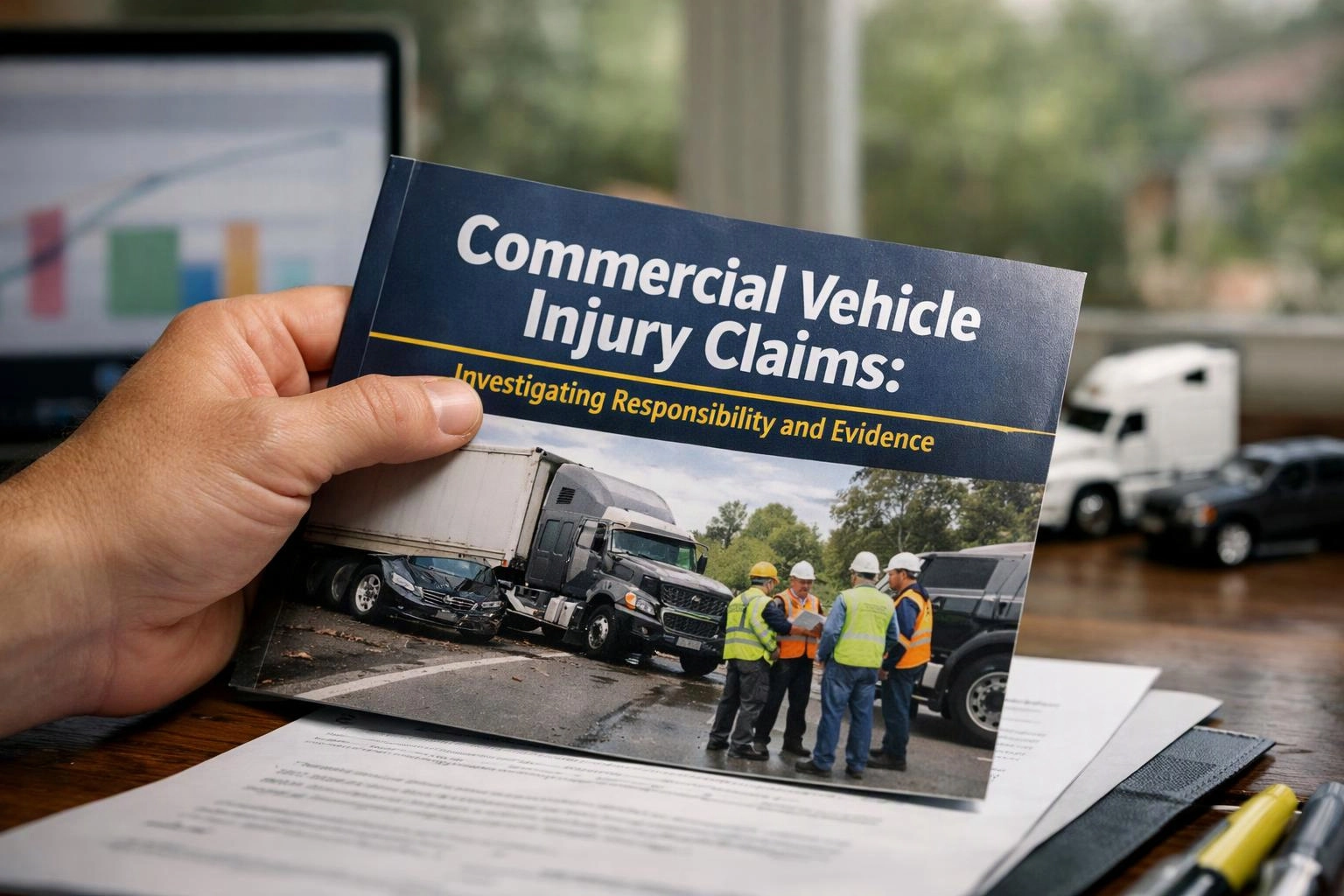
Commercial Vehicle Injury Claims: Investigating Responsibility and Evidence
Commercial vehicle accident claims can involve responsibility shared among drivers, businesses, or other parties. Atlanta Auto Law examines the evidence to identify potential claims and how each party may have contributed.
Written by Ronnie Mabra
Request an EstimateBy Ronnie Mabra
Can more than one party be responsible for a commercial vehicle crash?
Yes. A commercial vehicle crash can involve shared fault when separate actions contribute to the harm. We examine each possible role and how state law assigns responsibility.
Negligence generally means failing to use reasonable care and causing harm as a result. State liability law affects how fault is assigned and whether an injured claimant can recover damages. We apply the law that governs the claim to the available evidence.
Who may be responsible for a commercial vehicle crash?
A commercial driver, motor carrier, or vehicle owner may be responsible for a commercial vehicle crash. Atlanta Auto Law also examines whether a maintenance provider, cargo loader, or manufacturer played a role.
We review the driver's actions and the carrier's decisions. We also check who owned the vehicle and who controlled its use.
Poor repairs, unsafe cargo loading, or a defective part may contribute to a crash. We look for evidence linking those problems to the collision and the injuries. We also review potential insurance coverage for the parties involved.
When can truck and car accident claims overlap?
Truck and car accident claims can overlap when both vehicle types are involved or collisions are connected. We review how each vehicle and event relates to the injuries.
What evidence can show who caused the crash?
Crash evidence can show how a collision happened and who controlled the risks. We look for records that connect each party's actions to the crash.
We review the crash report, scene photos, and witness accounts. Available video, vehicle damage, and electronic vehicle data may help us test those accounts.
Driver logs and dispatch communications can shed light on the driver's work. We also examine inspection and maintenance records, as well as cargo records. These materials may help us trace a problem to the party responsible for it.
How do we investigate a commercial vehicle accident?
We investigate commercial vehicle accidents by preserving evidence and examining each party's role. Our Truck Accident Claims work can include reviewing vehicle records and business relationships.
We may send evidence preservation requests for records and vehicle data. We review scene and vehicle evidence and consider whether a vehicle inspection could help explain the crash.
We examine business relationships to see who controlled the driver, vehicle, or cargo. We also assess how each party's conduct connects to the injury. Applicable state and federal rules can help us evaluate that conduct.
How do truck and car accident claim investigations work together?
Truck and car accident claim investigations work together through a shared review of the crash and each party's conduct. We use that review to assess potential claims and the harm involved.
What should you know before pursuing a claim?
A commercial vehicle injury claim depends on evidence of the crash and the resulting harm. We offer Free Consultations to discuss the circumstances and our representation.
Medical records and injury documentation can help show how the crash affected you. We review those records alongside the liability evidence and insurance claim information.
Insurance communications may affect a claim, so keep the messages and documents you receive. Claim deadlines vary by jurisdiction, and we can discuss the rules that may apply to your situation.
Contact Atlanta Auto Law to discuss your crash and what our representation would include. We'll review your concerns during a Free Consultations appointment.
Request a QuoteWhat Are the Key Specifications to Know?
- Topic Focus
- Commercial Vehicle Injury Claims: Investigating Responsibility and Evidence
- Related Core Service
- Truck Accident Claims
- Evaluation Method
- On-Site Inspection & Written Scope
- Compliance Standard
- Local Building Code & Manufacturer Specs
How Does the Evaluation & Execution Process Compare?
| Evaluation Stage | Technical & Quality Criteria | Timeline Checkpoint |
|---|---|---|
| Initial Diagnostic & Assessment | Identify root cause, site constraints & code requirements | Before any work begins |
| Written Scope & Option Comparison | Compare repair vs. replacement tiers & material grades | Prior to project approval |
| Code-Compliant Execution | Follow manufacturer specs & local permitting standards | During active service |
| Final Verification & Walkthrough | Verify installation alignment, performance & clean site handoff | Upon project completion |
Related Resources
Hiring a Personal Injury Lawyer vs Handling the Claim Yourself
Compared ToChoosing a Lawyer With Experience in Your Type of Injury Claim
Brand vs BrandWhat to Compare When Choosing a Personal Injury Law Firm
Brand vs BrandAtlanta Auto Law vs Local Car Accident Claims Alternatives in Druid Hills: Side-by-Side Comparison